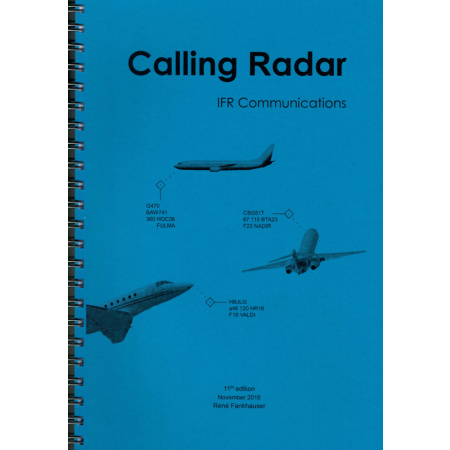
The textbook *Calling Radar* contains the most up-to-date phraseology procedures for IFR communication in accordance with ICAO documents. Most flight schools in Switzerland use it in theory classes and refresher courses.
Clear and unambiguous radio communication (Radiotelephony/RTF) between the pilot and air traffic control is crucial for safe and efficient flight operations. ICAO phraseology was developed to ensure that communication remains efficient, clear, concise, and unambiguous. It should therefore be used consistently and correctly in all situations where it is applicable. However, it is not possible to establish standard phraseology for every conceivable situation. The examples in this manual are therefore not exhaustive but serve as representative examples of the phrasing commonly used in radiotelephony. When the situation requires it, radio users should supplement the standard phraseology with “plain language,” taking care to keep their statements clear and concise.
"Calling Radar" covers all phraseology procedures listed in the learning objectives for IFR communication in accordance with EASA Part-FCL.615 (Subject 092) and described in the ICAO documents (Annex 10, Vol. 2, Doc 4444, Doc 9432). VFR communication is not covered in this book, as it is considered a prerequisite for IFR communication. However, it is also tested on the exam.
Even though at most airports the first part of the ATC en route clearance is published as a Standard Instrument Departure (SID), there are still airports that use “open clearances.” These include a detailed description of the route and flight levels in the terminal area. ATC en route clearances must always be read back, which is why verbal practice is essential. Symbols and abbreviations can be used to quickly write down the clearance.